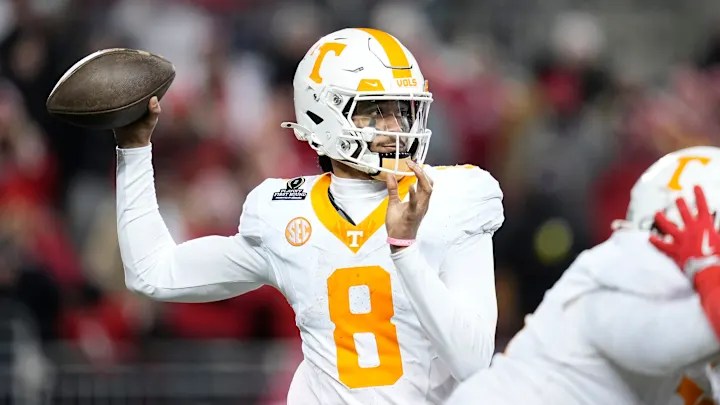
Hello, welcome back to All Things Sports! We are going to pretend like I have kept up with this blog “for the love of the game” since I went to college even though the only reason I am writing my first post from college is because I really do not want to write a paper right now. Having been exposed to College Athletics as both a fan and from the aspect of Athletic Compliance, it is wild to see how collegiate sports is evolving… and it’s also a little scary. With the landmark House vs NCAA case seeming like a done deal, schools like Oregon having unlimited recruiting budgets now, the NCAA banning transgender athletes, the landscape is completely different from even the start of the COVID pandemic. The best case of this is Nico Iamaleava.
Nico Iamaleava (what a name by the way) was the starting quarterback for a University of Tennessee football team that just made the College Football Playoff (and got obliterated) last season, so you’d think he’d love his current place and would view this as a great chance to make the NFL. Right?
Well no, according to Yahoo Sports, he has officially left Tennessee, with the report stating that UCLA is where he will end up. The departure stemmed from a dispute between Iamaleava and the school’s NIL (Name Image and Likeness for my rock dwellers) collective over how much money he was set to receive from the collective. See, ever since the Alston vs NCAA decision allowed student-athletes to profit off their Name Image, and Likeness rights, schools have been funnelling money to students through NIL collectives that are “not associated” with universities that help students capitalize on their NIL rights through all sorts of methods. This has made College Sports, specifically football and basketball since other sports don’t have as much money involved, extremely lucrative. For example, Oregon has the financial backing of Nike (and they still lose). For Iamaleava, Tennessee’s collective was offering too little to him. How much was “not enough” for Iamaleava? 2 million dollars. Yeah, he wasn’t happy with 2, he wanted 4 million, but as Tennessee coach Josh Heupel said no player is bigger than the “Power T”.
Also side note #100, but Iamaleava was NOT worth 4 million. I get that he was a 5 star but he was NOT IT in the CFP or anytime I saw his stat lines to be honest.
Back to the business of collegiate sports, I should note that the report also states that Nico’s father and close family and friends have come out and said that this wasn’t about the money, but that was 5 days after the initial report came out, and only when it was announced he was transferring to UCLA. That is WAY too late to be a legitimate defense in the modern media cycle. Another report has come out saying that him and other UT (not austin) players threatened to SIT OUT OF THE COLLEGE FOOTBALL PLAYOFF over NIL disputes, effectively trying to leverage playoff participation to get more money. By the way what good is making the playoffs if you get beaten 42-17 while looking bleak for 90% of the game. Even if it is true that this was not about the money, other players have been credibly found threatening to transfer simply for NIL money, effectively turning College Football into free agency once the transfer portal ends. Iamaleava is not the first nor the last, but rather the hallmark of what college football has turned into: the NFL. With free agency, TV rights, (a more entertaining product 😬) and other signs, college football is just the NFL with kids participating in class from time to time. If Moh Bility (Rice legend) can get 40k just for his name then why should he have to go to our Sport Management class?
This brings us to some implications (practicing for next year’s speech already i know). First is that amateurism is officially gone in college football and men’s college basketball (and a select few athletes like Oliva Dunne). Now I support NIL because if corporations are going to profit off their hard work, they should get money too (not like Iamaleava deserves 4 million but when they’re making 60 million off of his football it makes sense). However, when people have the ability to transfer wherever they want to go based on who pays them the most amount of money, that’s not an amateur league with the sole goal being development on and off the field. That’s a business. That’s not “collegiate”, that’s professional. The second implication is that student-athletes have way less incentives to focus on academics at certain schools because they can make crazy sums ju And why should they??? Refer to the example earlier where skipping class to go film an ad can make you thousands of dollars (if you play football or basketball) and that is not entirely harmful. Is it bad? In the long run, yes, student-athletes should stay in school to protect their long-term future by getting a degree that they can turn into a fulfilling career. But, in the short run (5 years), it can act as a safeguard against an injury that prevents someone from turning professional or allow student-athletes to maximize their value while they have it as they probably won’t have that same value after turning pro. And that’s if you turn pro. The 3rd implication is, on a broad scale (not necessarily at every school), a lot of athletics programs are going to only focus on football, men’s basketball, and women’s basketball (as the WNBA continues to grow women’s basketball) because they are the only ones that will make the money they need to be competitive in the Wild West of Collegiate Sports. We have already seen St.Francis University announce they are going to Division 3 after making the NCAA tournament because of money issues, so to stay in the green, many athletics programs will focus on sports that will keep them afloat. For other student-athletes that work just as hard, they are going to miss out on a lot of money, and a lot of opportunities.
How does this make Nico Iamaleava…. Thanos? Because both were inevitable. Iamaleava’s case was inevitable from the moment that college sports got money involved. Not when universities sold tickets and concessions, but when advertising, TV rights, and everything else came into college sports, it was only a matter of time before the players got their fair share. If we as a society wanted to protect amateurism, don’t let ESPN make money off the CFP. Obviously, that was never going to happen, so this was inevitable. And just like Thanos, Iamaleava’s decision (snap didn’t make sense) will change the future not just by serving as a catalyst for the implications discussed above but also by setting a precedent that anyone can transfer anywhere. The fact that he was able to leave Tennessee and had the confidence to reach out to Oregon to gauge interest (according to Sports Illustrated) suggests that players are empowered to a whole new level (again not necessarily bad). While teams are pushing back against Nico , eventually, some player will come around that is worth the money, and a bidding war will ensue, and then Nick Saban will cringe and complain so much that everyone in the nation will hear him (he really did see this coming to be fair).
In the end college sports is changing in a way that nobody saw coming a decade ago, but we probably should have. Players deserve compensation, and while some are asking for too much, this shift lookspermanent. In the future, as the business gets more lucrative, all I can ask is that student-athletes please show up to class because some of us want to get good grades on the group projects. Thanks for reading.
 All Things Sports
Leave a comment